

/ News, Forschung, Events, People, Campus
Salon Discussion with Dr. Idriss Jebari (Trinity College Dublin): “Leaping Decolonization: North Africa in the Global 1960s and 1970s”
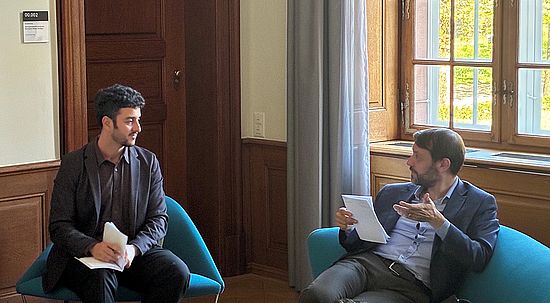
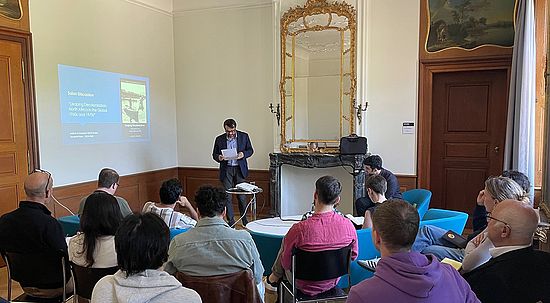
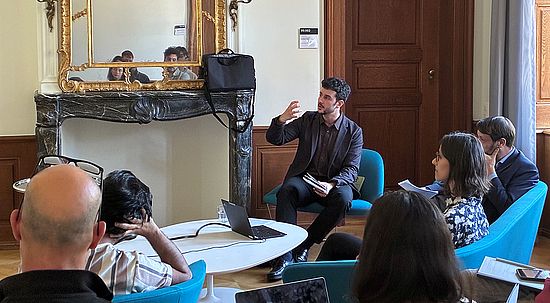
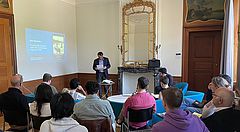
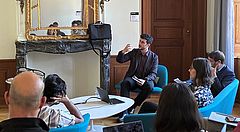
On 22 April 2026, Dr. Idriss Jebari, Lecturer in Middle East Studies at Trinity College Dublin, presented the research from his new book, Leaping Decolonization: North Africa in the Global 1960s and 1970s (Cambridge University Press: 2026). The salon discussion attracted a number of researchers from across the EIB’s disciplinary spectrum, leading to a lively exchange of ideas on history, philosophy and politics, as well as methodology and research challenges.
Idriss Jebari’s innovative and engaging presentation was based around four photographs, which he used to highlight various elements of the intellectual debates that shaped North Africa from the early 1960s to the early 1980s. The processes of intellectual decolonization led by the first post-independence generations of scholars and political leaders in Algeria, Morocco and Tunisia often had their beginnings in print media. Periodicals from the 1960s and 70s provide rich insight into the broader intellectual communities of the time, their agency in navigating their new circumstances, and their imagined futures, frequently fraught with tensions between ideas of tradition and modernity. But they can also be considered only the tip of the intellectual iceberg, often containing early iterations of ideas and theories which were later developed in leading works. So why, Jebari asks, did these discourses have to be discovered, often by chance, in secondhand bookshops?
The answer lies in the nature of the regimes of these states, and the challenges to doing historical work without access to state archives. Overcoming these obstacles requires innovative solutions, such as the scouring of bookshops on the backstreets of Tunis and Casablanca described by Jebari. Writing these histories means bringing the self-representation of North Africa during its early post-independence period to the fore, giving space to these peripheral voices and disrupting the hegemony of centers such as Paris and Beirut in intellectual debates of the time.
The following day, on 23 April, Idriss Jebari also gave a guest presentation in Prof. Ralph Weber and Niamh O’Neill’s MA lecture course “Global Debates, Eurocentrism, and Methodology”, conceptualizing the climate crisis as a global debate from the perspective of the MENA region. Using the case study of Morocco’s Noor Solar Plant, he problematized the country’s “green transition” model and examined how the countries of the region are positioning themselves in relation to the global discourse of sustainability and transition.
Idriss Jebari is a Lecturer in Middle East Studies at Trinity College Dublin. He is a historian of Arab thought and the author of Leaping Decolonization: North Africa in the Global 1960s and 1970s (Cambridge University Press, 2026). After completing his doctorate on the history of the production of critical thought in Morocco and Tunisia at the University of Oxford, he held a postdoctoral research fellowship at the American University of Beirut (Lebanon), and at Bowdoin College in Maine (USA). His research has appeared in the International Journal of Middle East Studies, History of the Present, and Comparative Studies of South Asia, Africa, and the Middle East.